The Rise of Professional Robotic Café Technology: What COFE+ Is and Why It Matters
TL;DR — COFE+ is a fully automated robotic coffee kiosk that grinds fresh beans, brews espresso and lattes, creates latt……

Corporate campuses face a particular challenge with beverage service. Employees want quality coffee without leaving the building, facilities teams struggle with staffed café costs and inconsistent hours, and traditional vending machines fall short of the experience today’s workforce expects. A robot coffee counter offers a different path: built-in, automated, and capable of serving fresh-ground specialty coffee 24/7 from roughly two square meters. After working with corporate clients deploying unmanned retail across more than 35 countries, I’ve seen how the right automation choice changes not just the coffee, but how people use shared spaces. This article covers what procurement and facilities teams need to evaluate before committing to a robot coffee counter for a large corporate campus.
Corporate campuses typically handle coffee one of three ways: a staffed café or coffee bar, a bank of vending machines, or outsourced catering during limited hours. Each has a weak point that scales with campus size.
Staffed cafés deliver quality but carry labor costs, shift scheduling headaches, and coverage gaps during evenings, weekends, and holidays. On a campus with several thousand employees spread across multiple buildings, that means either running multiple cafés or forcing people to walk ten minutes for a cup. Vending machines solve the 24/7 availability problem but produce a product nobody gets excited about, and outsourced catering works for events, not daily service.
The operating cost comparison between these models and a robot coffee counter is where the automation argument gets concrete. A single robot counter replaces the labor of multiple baristas, eliminates shift scheduling entirely, and delivers consistent output whether it is 9 AM Monday or 2 AM Saturday. The unit runs on approximately $0.30 to $0.70 per cup in consumables and energy, and floor space needed is roughly two square meters. No build-out, no staffing, no locked doors after 5 PM.
One concern I hear from facilities directors is whether a robot coffee counter creates infrastructure demands that outweigh the convenience. In practice, the integration requirements are lighter than a traditional café build-out.
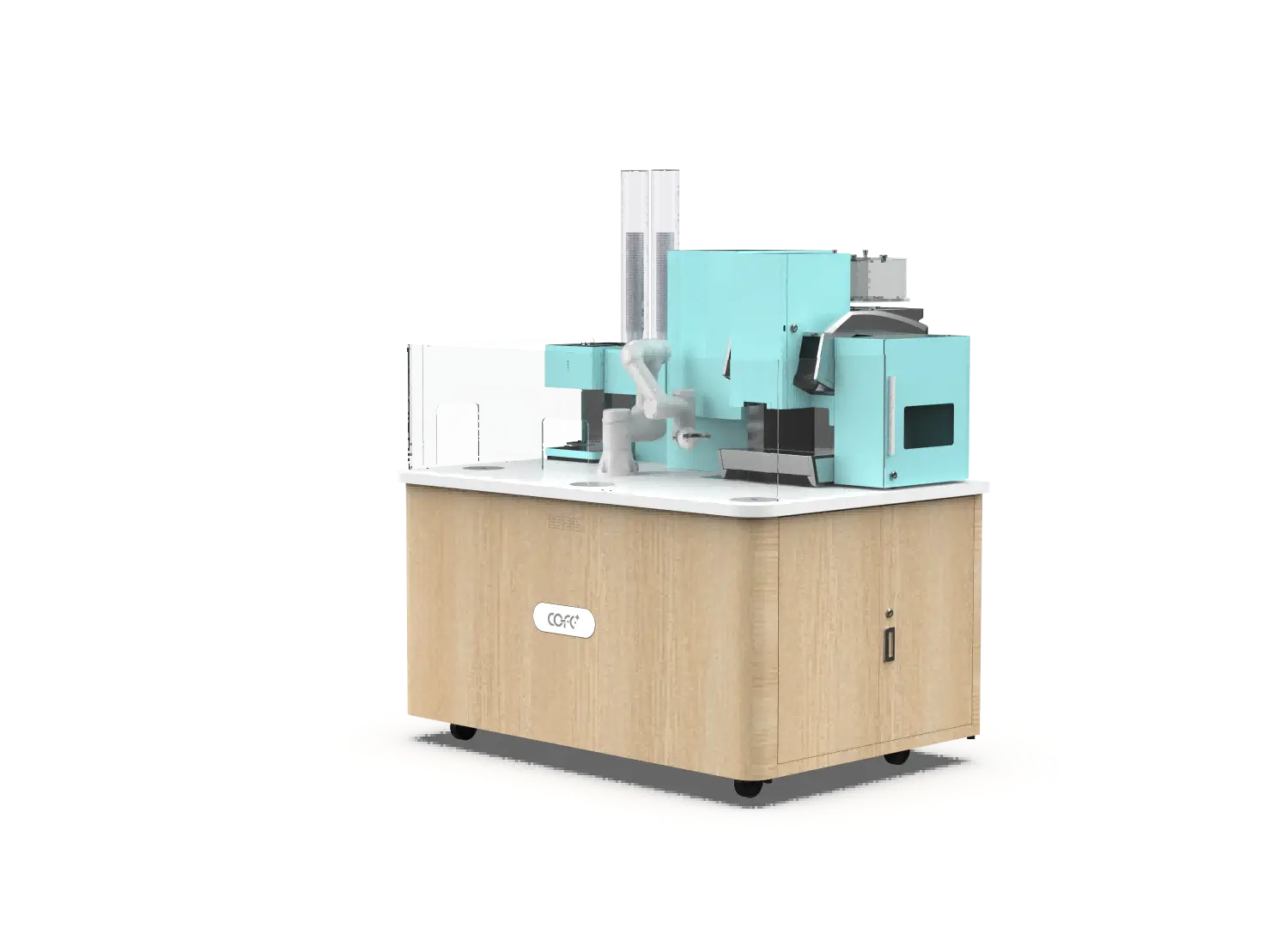
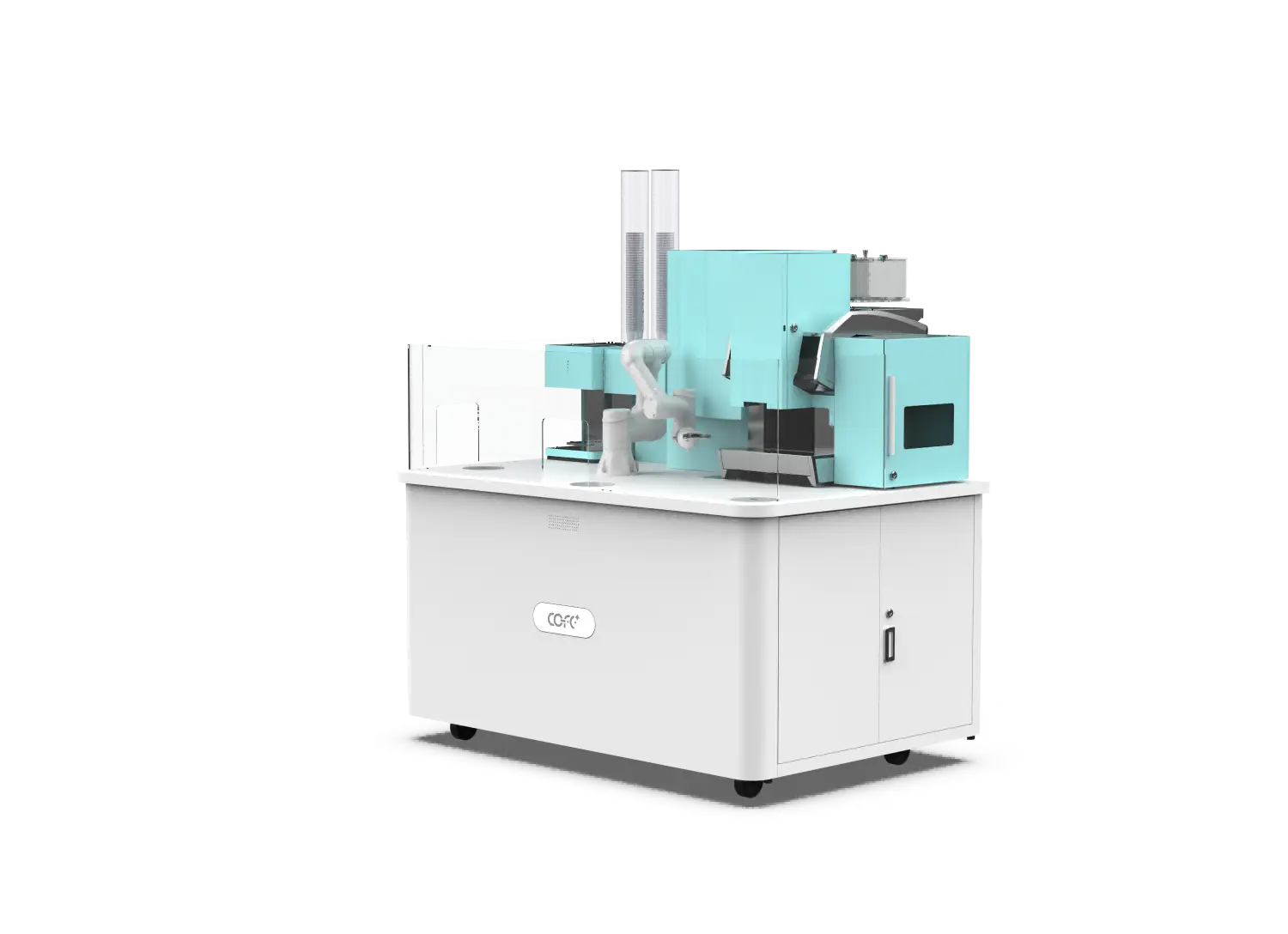
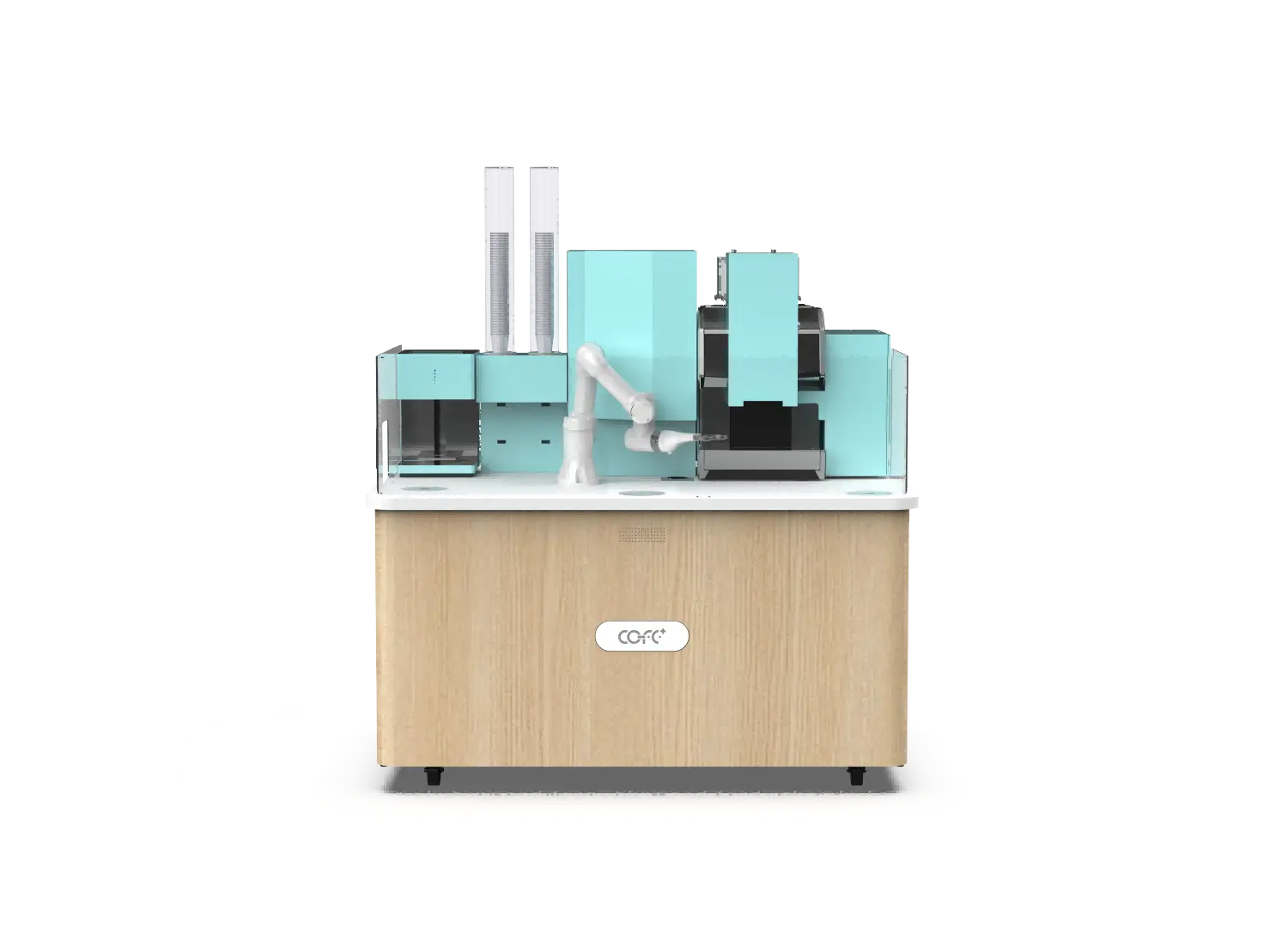
The COFE+ 7th Generation Robot Coffee Counter needs a standard power connection, a water line, and drainage. No gas, no ventilation hood, no fire suppression system. The counter format sits flush within an existing bar, reception area, or break room rather than occupying a dedicated food service bay. Buildings never designed for food service can still host one. This changes the placement conversation. Instead of one central café that everyone walks to, facilities teams can place counters in high-traffic zones across buildings: near meeting rooms, in executive lounges, adjacent to co-working areas. Each unit operates independently and is managed through cloud-based monitoring that tracks stock levels, cleaning cycles, and maintenance alerts remotely. No on-site barista, no daily opening and closing procedures.
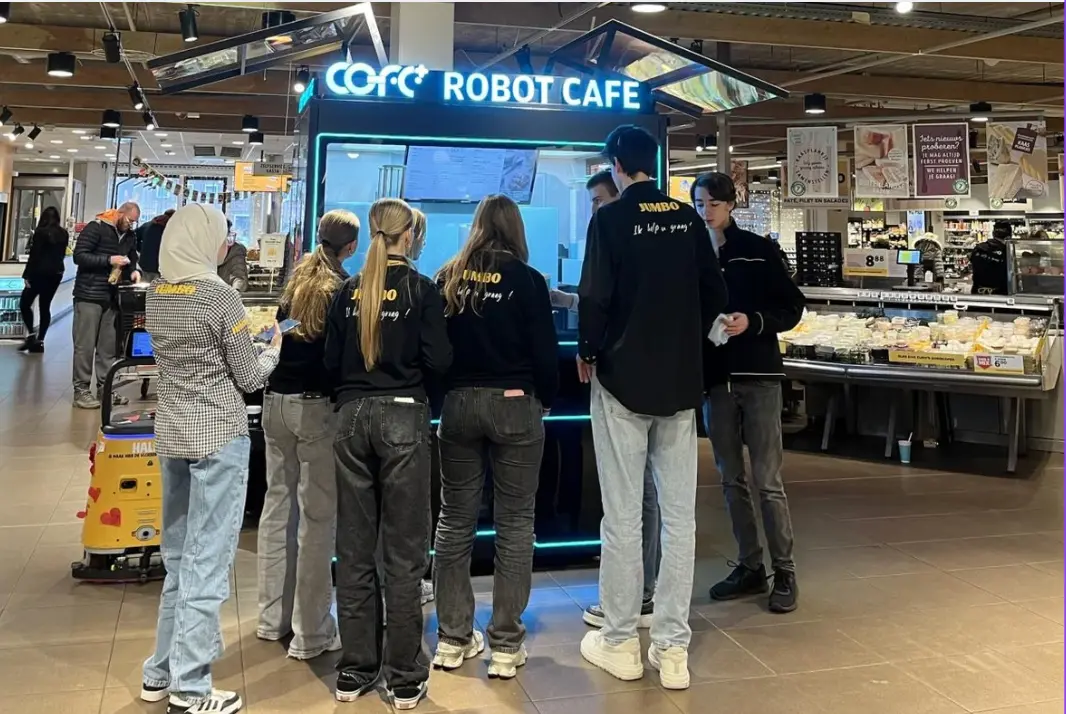
The counter’s open-view design also matters for integration. Guests watch the robotic arm grind beans, extract espresso, and print 3D latte art on foam. What would otherwise be a functional corner becomes a social focal point without adding staff or complexity. I’ve watched employees gather around these counters during breaks the same way they cluster around a traditional bar, except the consistency never dips and the counter never calls in sick.
If the coffee does not hold up, none of the operational math matters. Employees on a corporate campus compare the robot’s output to the specialty café they visit on weekends, not to a vending machine.
The 7th-generation counter serves more than 300 drink types drawn from 197 country-inspired recipes, with over 5,000 customization combinations spanning bean selection, milk type, syrup, roast level, and cup size. The system digitizes barista-level extraction parameters so cup three hundred matches cup one. Latte art comes in two forms: a robotic arm that can craft tulips, hearts, and rosettas on foam, and a 3D printing system that can render logos, portraits, or custom images on the drink surface.
For a corporate campus, the logo printing capability carries particular weight. Serving a latte with the company emblem on the foam during a client visit or board meeting signals investment in the workplace without saying a word. It is a small detail with outsized impact in premium office environments.
| Feature | Standard Vending Machine | Staffed Café | Robot Coffee Counter |
|---|---|---|---|
| Drink variety | 12-20 options | Menu-dependent | 300+ drinks, 5,000+ customizations |
| Operating hours | 24/7 | Limited by staffing | 24/7 unattended |
| Labor requirement | Restocking only | 3-6 baristas per shift | None (cloud-monitored) |
| Fresh-ground coffee | Rarely | Yes | Yes, digital recipe precision |
| Latte art | No | Barista-dependent | Robotic arm + 3D printing |
| Footprint | ~1 m² | 20-50+ m² | ~2 m² |
If your campus includes multiple buildings with distinct employee profiles, for instance R&D teams in one wing and client-facing teams in another, the menu configuration and placement strategy deserve more detailed discussion. The drink parameters that work for a research lab break room differ from what fits an executive briefing center. Reach out at sales@hi-dolphin.com with your campus layout and we can map the right configuration per zone.
The primary financial shift with a robot coffee counter is the elimination of direct labor. A traditional campus café running two shifts requires multiple baristas. Even at conservative wage estimates, annual labor costs reach six figures per location. Multiply across a multi-building campus and the number becomes a line item facilities directors notice.
With the robot counter, the per-cup cost drops to roughly $0.30 to $0.70 in consumables, covering beans, milk, syrups, cups, and energy. Pricing to employees typically falls between $2.50 and $5.00 per drink depending on the organization’s subsidy policy, producing a margin that supports payback within six to twelve months for most deployments.
There is a broader cost that does not appear on a P&L but matters on a corporate campus: time. When employees leave the building to buy coffee, a fifteen-minute walk becomes half an hour. At scale, this time loss across hundreds or thousands of employees represents a meaningful productivity drain. An on-site counter that delivers café quality eliminates that drain entirely.
Equipment durability also factors into the calculation. The counter is rated for a ten-year lifespan and has been endurance-tested through more than 500,000 cups. Facilities teams accustomed to replacing commercial espresso machines every three to five years will find the capital depreciation timeline considerably more favorable.
On the compliance side, the COFE+ robot coffee counter holds over 50 certifications accepted across more than 18 developed countries, including FDA, CE, UKCA, KC, and SASO approvals. The food-contact surfaces use antimicrobial stainless steel, and the system runs automatic high-temperature sterilization cycles above 85°C. Hygiene becomes a documented output rather than a training-dependent variable. Maintenance is cloud-connected: the unit monitors its own temperature, stock levels, mechanical performance, and cleaning status, flagging anomalies before they become failures. Remote diagnostics handle most issues without an on-site visit.
For corporate campuses with sustainability reporting requirements, the waste profile differs from a traditional café. Ingredient dispensing is portion-controlled, eliminating over-pouring and batch waste. Cups and consumables inventory tracks precisely against output, which supports both cost control and waste reduction reporting.
A corporate campus represents a long-term investment environment. The coffee solution selected today will be compared against alternatives for years across multiple stakeholder groups. Getting the evaluation right at the procurement stage avoids downstream friction.
I recommend procurement teams request three specifics from any robot coffee counter supplier: the full certification documentation for the target deployment countries, a deployment-specific break-even projection based on estimated campus traffic rather than generic market averages, and the maintenance response protocol with guaranteed response times for your time zone. A counter that works beautifully in Shanghai or Dubai may behave differently in a campus environment with specific water chemistry, power stability, and usage patterns. The supplier should be able to speak to those variables with real deployment data, not marketing claims.
Hi-Dolphin operates robot coffee counters in more than 35 countries and across 15 provinces in China, which means the support infrastructure and compliance documentation already exist for most procurement teams’ requirements. If your campus spans multiple regions or you need configuration advice for a specific building layout, send your campus parameters and timeline to sales@hi-dolphin.com or call +86 131 6630 1290. We can build a projection specific to your buildings rather than generic averages.
No. The system runs fully unattended 24/7. Cloud-based remote monitoring handles stock tracking, temperature regulation, and maintenance alerts. Restocking ingredients and emptying waste takes a facilities team member roughly ten minutes per day per unit, comparable to servicing a high-end vending machine. The counter is designed so that existing campus maintenance staff can handle daily upkeep without specialized coffee equipment training.
The 7th-generation counter produces a drink in roughly 43 to 60 seconds and can handle approximately 1,000 cups per day of continuous operation. During peak morning windows, queue management depends on placement. For campuses with heavy early-morning traffic, placing two counters in adjacent zones or selecting high-visibility corner locations with natural queue space resolves congestion better than a single hidden unit. The placement decision matters more than the machine speed.
The menu supports 5,000-plus drink combinations including bean selection, milk alternatives, syrup flavors, roast profiles, and cup sizes. For organizations with a specific coffee program or regional taste preferences, the recipe database can be configured to prioritize certain drinks. The 3D latte art system also supports custom logo printing, which several corporate clients use as part of their workplace hospitality identity. The coffee itself is fresh-ground and extracted to digital parameters that match specialty café standards.
A robot coffee counter typically reaches payback within six to twelve months based on labor elimination and per-cup margins. For a campus with over 1,000 employees and no existing staffed café, the payback can land closer to six months because the counter captures demand that was previously lost to off-campus coffee runs. The key variable is utilization rate, which is why deployment-specific traffic modeling produces more useful projections than industry averages. If your campus has specific employee count data and current coffee spend figures, sharing those with a supplier will produce a break-even model you can actually defend to finance. Send your campus parameters to sales@hi-dolphin.com and we’ll build a projection specific to your buildings.
TL;DR — COFE+ is a fully automated robotic coffee kiosk that grinds fresh beans, brews espresso and lattes, creates latt……
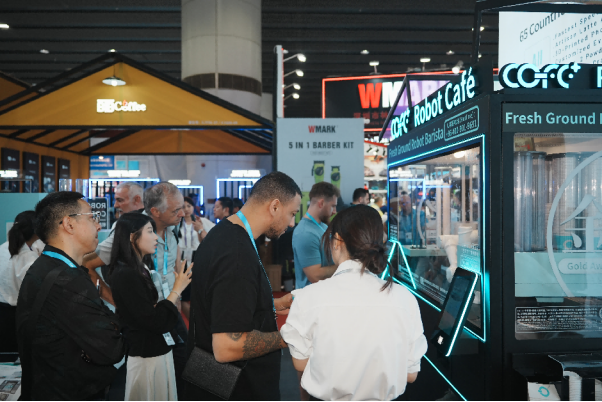
7th-Genertion Smart Robot Coffee Kiosk Arrives at the Belt and Road Core Hub, Ushering in a New Service Era Along t……
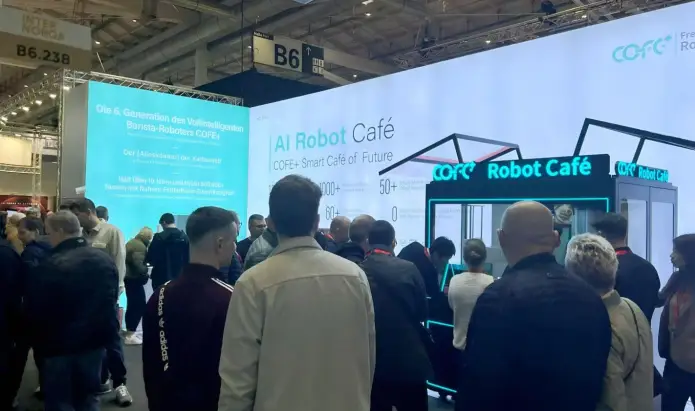
CHICAGO, May 12, 2026 (GLOBE NEWSWIRE) – Shanghai Hi-Dolphin Robot Technology today announced the U.S. debut of its 7th‑……