The Rise of Professional Robotic Café Technology: What COFE+ Is and Why It Matters
TL;DR — COFE+ is a fully automated robotic coffee kiosk that grinds fresh beans, brews espresso and lattes, creates latt……

Universities run on caffeine, but staffing a café that matches student demand is a losing battle. Morning rush hits in a 20-minute wave between lectures. Evening study sessions stretch past 11 p.m. Hiring baristas who show up at 6 a.m. to prep and still handle the 3 p.m. lull without burning labor budget is a scheduling problem that rarely solves itself. A robot coffee kiosk built for high-volume, unattended operation changes the equation — delivering consistent specialty coffee without a single employee on the floor.
A typical university coffee shop needs five to seven baristas just to cover 7 a.m. to midnight, with three or four on shift during peak. Each hour of downtime because someone called in sick costs 80 to 120 missed cups and a line that turns students away. The bigger the campus, the worse the math gets because student cohorts move in synchronized blocks. When 3,000 people leave the same lecture hall at the same time, a four-person barista line cannot keep up.
We have seen campus operators try mobile pre-ordering, self-service drip stations, and grab-and-go coolers. Pre-ordering helps but still requires a person to stage drinks. Drip stations sacrifice the specialty drinks that students actually pay for. And none of these reduce the dependency on labor.
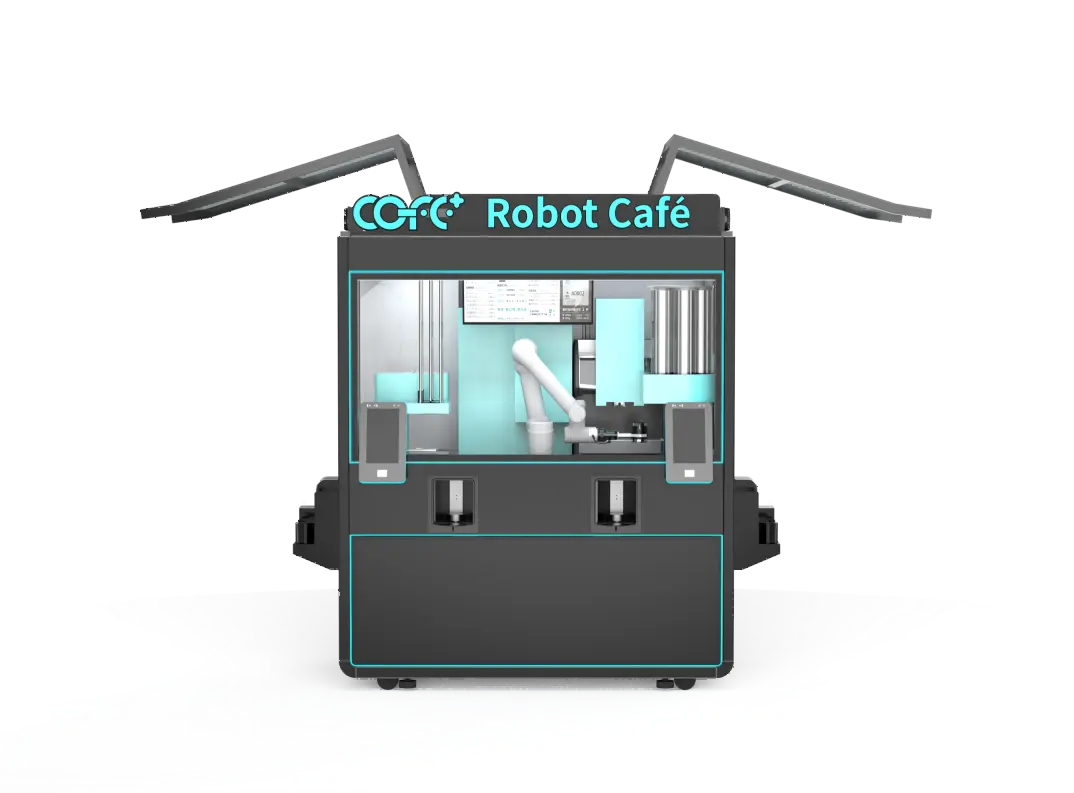
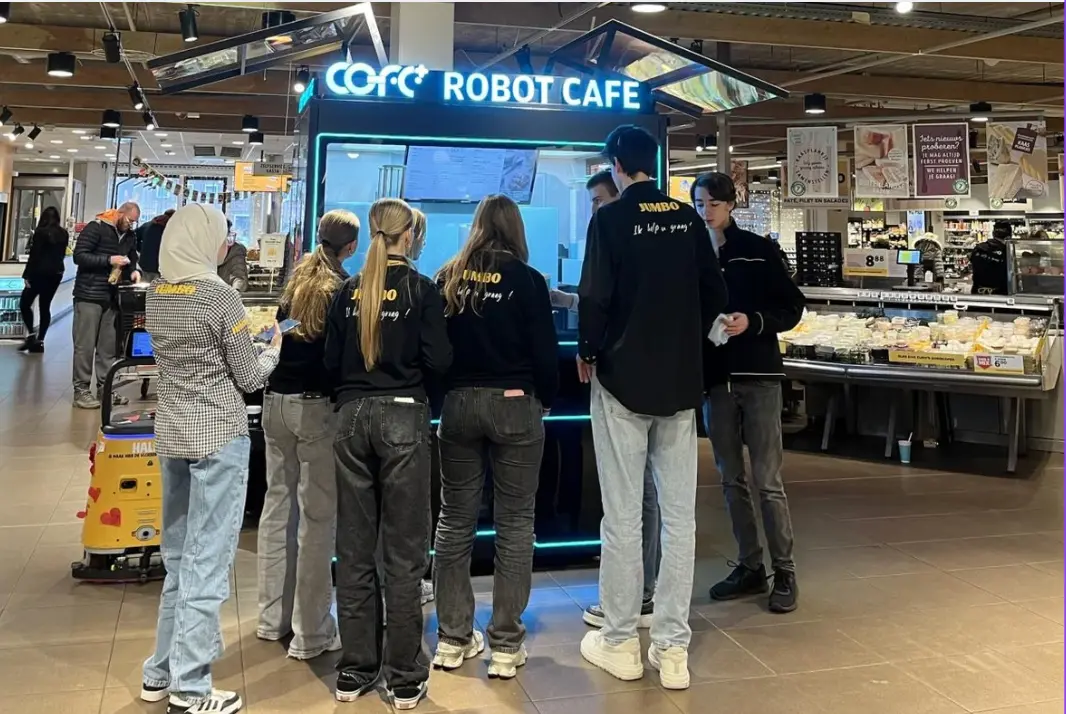
The COFE+ 7th generation indoor robot coffee kiosk is rated for approximately 1,000 cups per day, with a per-cup cycle time of 43 to 60 seconds depending on the drink. That speed comes from parallelized grinding, extraction, and milk preparation — not a single sequential arm. During the heaviest campus waves, the machine can run continuously for hours because all moving parts are electromechanical and cooling systems are thermally modeled for sustained load, not occasional use.
Drink consistency is where a lot of automated systems fall apart. After 200 consecutive cappuccinos, milk temperature can drift, grinders heat up, and shot volumes walk. COFE+ uses digitized recipes that lock extraction time, grind size, water temperature, and milk texture per drink profile. The result is not a vending machine approximation; it is a calibrated barista workflow executed the same way every cup. Across a deployment test of 300 consecutive lattes, shot time variance stayed under 1.5 seconds and milk temperature under 2°C. That is tighter than most manual bars.
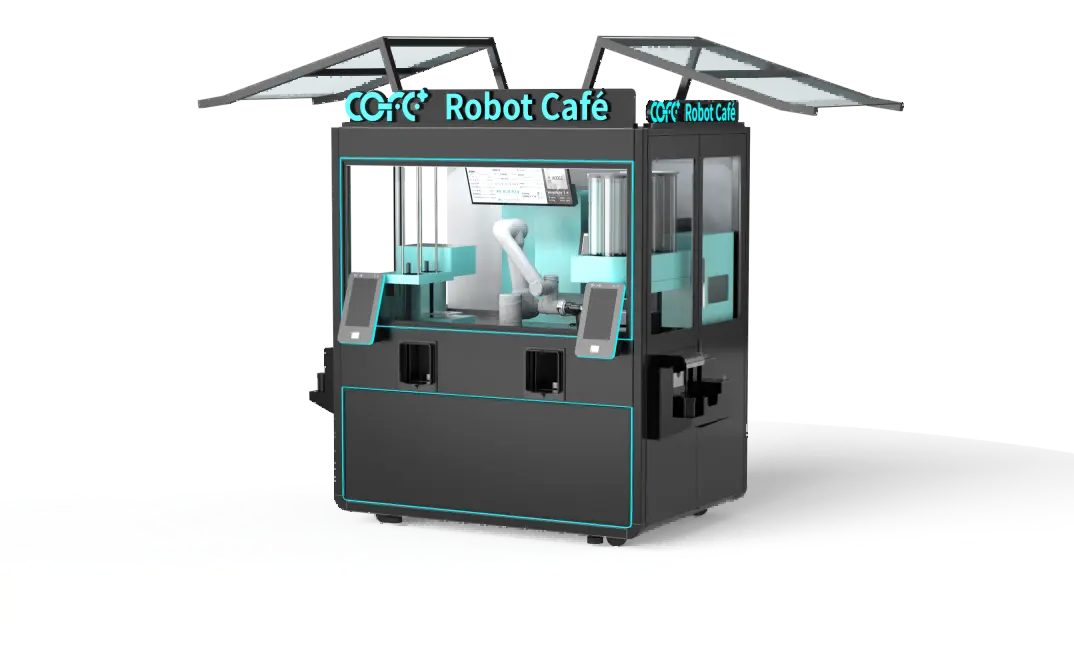
Throughput matters more than daily capacity. A kiosk that can make 1,000 cups in 24 hours but only 35 per hour during peak falls short when 200 students hit it in 30 minutes. The indoor model sequences dual-group brewing with a robotic arm that can prep the next cup while finishing the current one. For a double-shot latte, the effective rate is about 50 to 55 cups per hour, sustained. Students order via a touchscreen; payments process in under three seconds. The interaction is faster than speaking a custom order to a barista.
Campus deployment also removes the shift-change problem. A 24/7 kiosk serves the 10 p.m. library crowd, the 6 a.m. gym goers, and the Saturday afternoon visitors. There is no overtime, no minimum shift, and no manager calling around to cover a gap. The machine’s smart store brain monitors stock, temperature, and cleaning cycles remotely, sending alerts when milk or beans are low. Maintenance is typically one visit per day to restock and rinse components; the system self-cleans the brew path and steam wand between cycles.
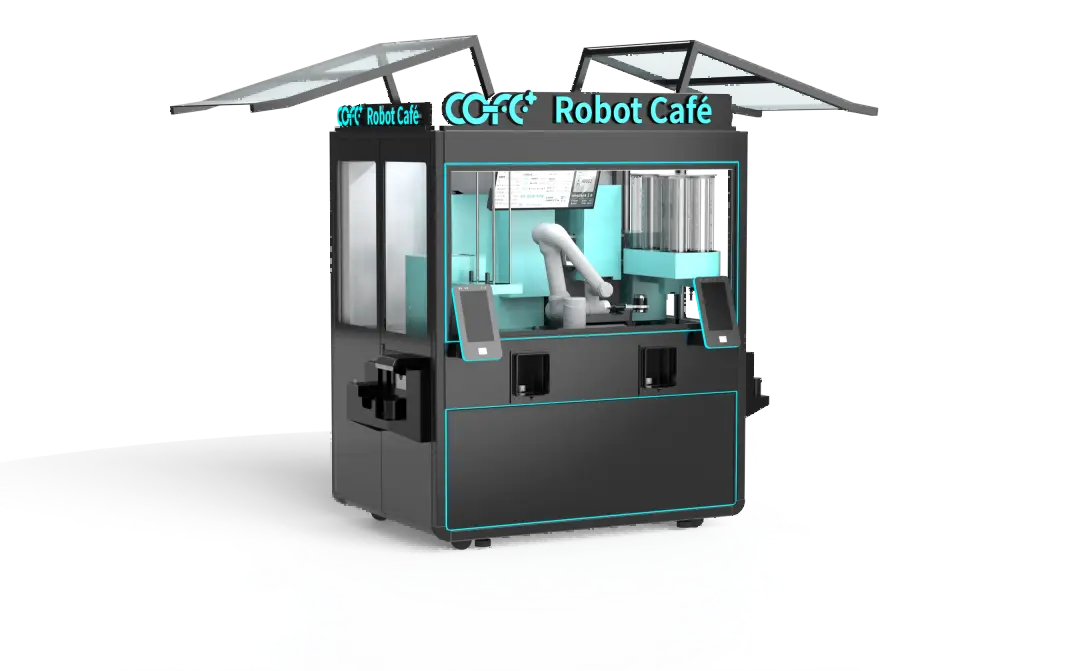
The indoor kiosk has a footprint of about 2.35 square meters, roughly the size of a small information desk or a compact photo booth. It runs on standard single-phase power and connects via Wi-Fi or wired Ethernet. No plumbing retrofit is required beyond a bottled water feed or a small point-of-use tank system. We have placed units in student union corridors, under library stairwells, next to lecture hall entrances, and inside residence hall lobbies without construction.
Placement decisions should prioritize proximity to lecture clusters and study spaces, not foot traffic alone. A kiosk near three 400-seat lecture halls will print more revenue than one in a main plaza where people walk through but do not dwell. The unit’s sound level during operation is about 55 dB, comparable to background conversation, so it works even in quiet study zones if buffered by a small alcove or partition.
| Placement Factor | Traditional Café | Robot Kiosk |
|---|---|---|
| Required floor area | 30–50 m² | 2.35 m² |
| Set-up time from decision to serving | 8–16 weeks | 2–3 weeks |
| Staff required per shift | 3–4 baristas | None |
| Peak cups per hour | 80–120 (varies by staff) | 50–55 (consistent) |
| 24/7 operation | Requires shift coverage | Built-in |
One practical barrier that campus operators raise early is payment system integration. Students carry university-issued ID cards with stored value, meal plan credits, or campus cash. COFE+ supports standard card readers, mobile wallets, and QR payment. Integrating a campus card into the kiosk’s payment terminal is typically a one-week coordination with the university’s card office, and once configured, transactions clear through the same system as dining hall sales. This means no separate cash handling and no student needing a different payment method just for coffee.
Remote monitoring cuts the operational workload further. Through a cloud dashboard, site managers see real-time sales by drink, ingredient levels, and any predictive maintenance flags. If a chiller unit starts pulling above-normal current, the system flags it before a failure causes downtime. Because the kiosk operates 24/7, a single staff member can manage multiple campus units with one daily visit, instead of staffing each location.
At a cost of approximately $0.30 to $0.70 per cup for ingredients and consumables, and no labor cost, the margin on a $3.50 latte is substantial. Even after accounting for daily restocking labor, electricity, and periodic deep cleaning, operators typically see a payback in 12 to 18 months on a single unit placed in a high-traffic hall. Campuses with meal plan integration and captive audiences often outperform that because students do not leave campus for coffee.
The replacement value is real. One kiosk running 20 hours a day replaces about six barista positions when you factor in shift overlap and coverage for days off. That labor cost, including recruiting, training, and turnover, is the largest single line item in a campus café P&L. Removing it while maintaining a specialty-grade drink menu flips a loss center into a net revenue generator, even before factoring in the revenue from overnight hours that a staffed café cannot serve.
If your campus program involves a high-traffic location with demonstrable student flow and you are comparing the robot kiosk against a staffed outlet, it is worth confirming your expected daily cup count and campus card compatibility before finalizing your budget. Share your projected volume and site constraints with us at sales@hi-dolphin.com, and we will provide a layout and throughput estimate specific to your campus footprint.
Can students customize drinks as much as they do with a barista?
Ordering includes selecting bean type, milk or plant-based alternative, syrup type and quantity, roast level, and drink size. A student who wants an oat milk flat white with an extra shot and half vanilla syrup is about 15 seconds of touchscreen taps. The robotic arm and recipe engine produce exactly that. Customization depth is comparable to a specialty café, not a push-button vending machine.
Is the kiosk safe for unattended operation in a student area?
The unit is built with an enclosed preparation area, spill containment, and automatic high-temperature sterilization above 85°C for drink-contact surfaces. It is CE, FDA, and UKCA certified. The exterior is vandal-resistant and there is no way for a user to reach internal mechanics during operation. In deployments across 65 countries, we have not seen safety incidents related to unsupervised use.
What happens when the machine runs out of milk or beans?
The cloud monitoring system sends low-stock alerts to the operator before a full run-out. In a campus with daily restocking, the worst case is a student encounters a “temporarily unavailable” item on the menu, not a full machine shutdown. The system also detects when it is low on cups and lids.
Does a robot coffee kiosk really match the quality of a trained barista?
Our internal testing and third-party evaluations show shot consistency and milk texture within championship-level parameters. The machine replicates the workflow that a skilled barista would use, minus the human variables of fatigue and distraction. Taste tests with blind panels consistently find the output indistinguishable from a specialty café; the variable is not the machine’s capability but whether the operator uses quality beans and fresh milk.
How much does a robot coffee kiosk cost for a university?
Pricing depends on configuration, but operators can expect a payback of 12 to 18 months in typical campus settings. For a university with known foot traffic and an existing card payment system, the unit often becomes profitable within the first academic year. If you share your student volume and location plan, we can provide a payback estimate that accounts for your specific campus pricing strategy. Reach out at sales@hi-dolphin.com or call +86 131 6630 1290 with your expected daily cup count and we will return a detailed cost projection.
TL;DR — COFE+ is a fully automated robotic coffee kiosk that grinds fresh beans, brews espresso and lattes, creates latt……
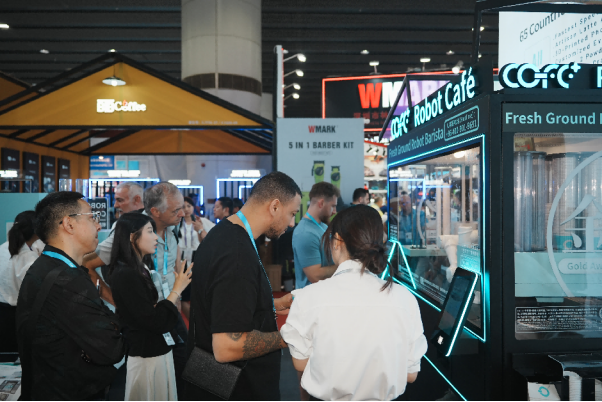
7th-Genertion Smart Robot Coffee Kiosk Arrives at the Belt and Road Core Hub, Ushering in a New Service Era Along t……
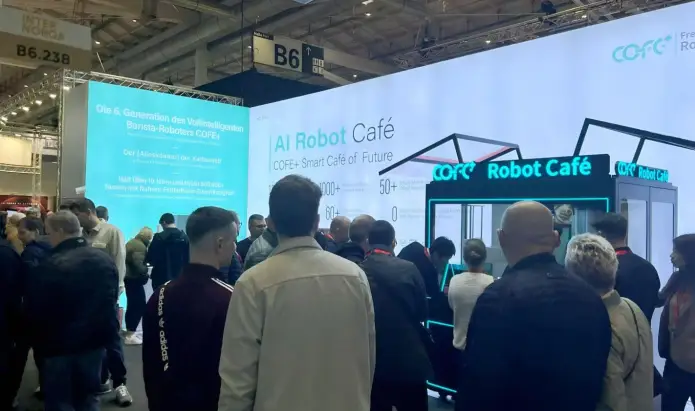
CHICAGO, May 12, 2026 (GLOBE NEWSWIRE) – Shanghai Hi-Dolphin Robot Technology today announced the U.S. debut of its 7th‑……