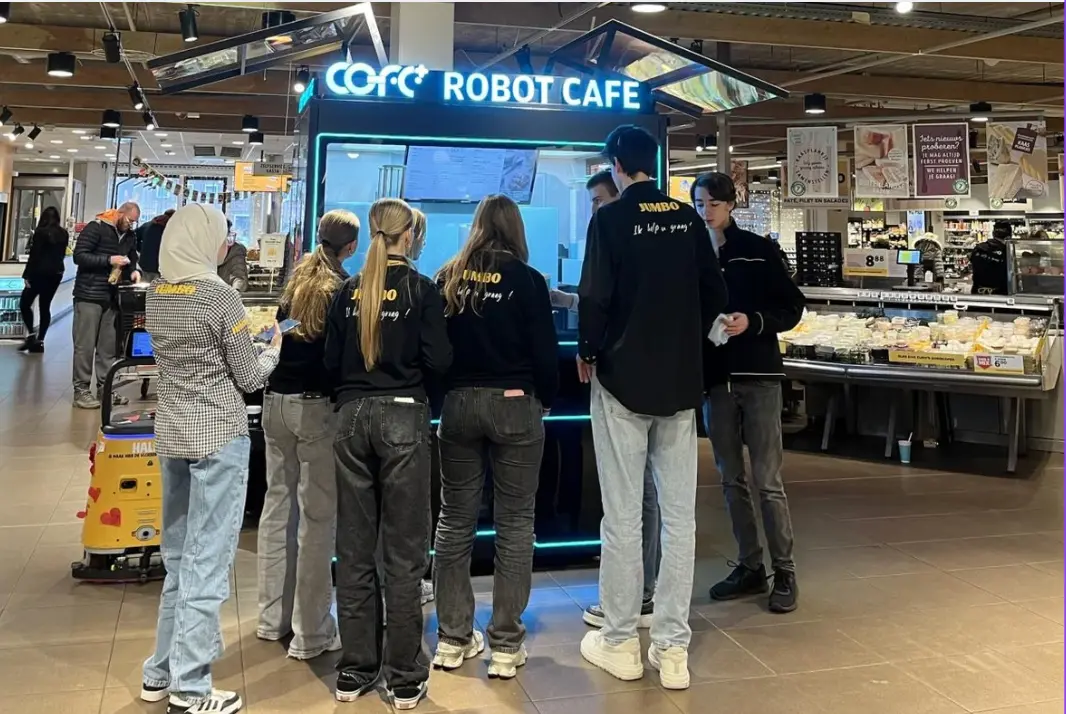
The Rise of Professional Robotic Café Technology: What COFE+ Is and Why It Matters
TL;DR — COFE+ is a fully automated robotic coffee kiosk that grinds fresh beans, brews espresso and lattes, creates latt……

Scaling coffee quality across multiple sites has always been a staffing challenge, because human baristas, no matter how well trained, introduce incremental variability into every cup. I work with operators who run 20, 50, or 200 points of sale, and their biggest fear isn’t machine uptime—it’s that a customer in London tastes a different espresso from one in Dubai. Robot baristas solve this by digitally locking every brewing parameter into a closed-loop system that doesn’t drift, doesn’t cut corners at rush hour, and reproduces the same extraction 500,000 times before requiring any recalibration.
Most coffee quality failures happen at the margin: a tenth of a gram of coffee grounds, a second off extraction time, milk foam that collapses because the wand wasn’t purged. Robotics eliminate those margins by replacing manual judgment with sensor-driven actuation. In our seventh-generation COFE+ system, the robot arm does not interpret a recipe—it executes it.
The core mechanism is a real-time feedback loop. During grinding, a laser particle analyzer checks the grind distribution and adjusts burr spacing on the fly. The pump delivers water at a preset temperature profile, typically rising to 93°C for a medium roast, held within a ±0.5°C window, monitored by a thermocouple at the group head. Extraction pressure is disk-valve controlled to maintain 9 bars, regardless of tamp density, because the robotic tamper applies a consistent 15 kg force every time. Milk texturing is even more tightly governed: the steam wand angle, steam pressure, and milk volume are calibrated for the specific drink—so a flat white gets microfoam at 60°C, not the 65°C you’d want for a cappuccino. The result is a drink that matches the digital recipe within a tolerance smaller than what sensory panels can typically detect.
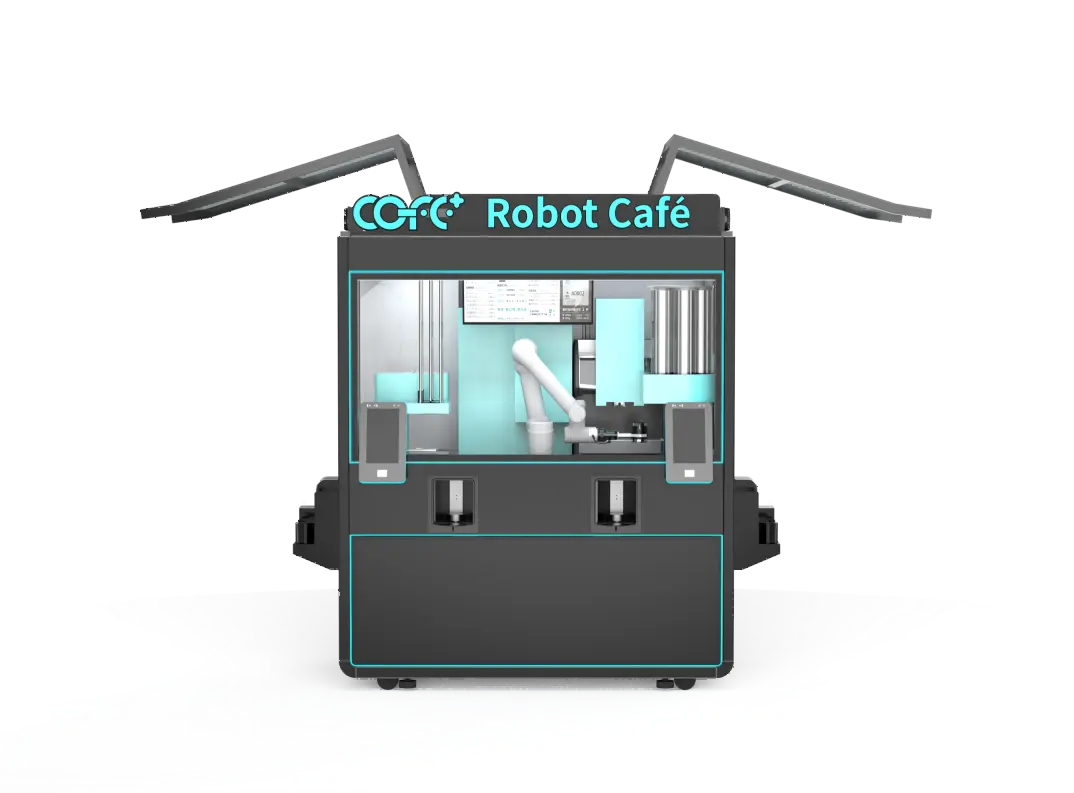
Temperature and humidity affect coffee extraction, so the robot’s environmental sensors feed hourly calibration data into the brew logic. At an outdoor kiosk in Dubai, where ambient temperatures can swing from 14°C at night to 40°C midday, the machine compensates by adjusting pre-infusion time and pump stroke volume—nothing a human barista could do consistently across a shift. This automatic adaptation keeps extraction yield within one percentage point of the target, which is within Q-grader tolerances.
A single barista can learn twenty recipes, but a robot kiosk stores thousands without performance decay. What gives the digital recipe system its reliability is the combination of source traceability and brew logging. Every ingredient—the bean origin, roast date, milk fat percentage, syrup batch—is scanned into the system at loading, and the machine will refuse to brew if a parameter falls outside its acceptable range. That might mean it won’t pull a shot with beans older than the freshness window you’ve set, or it will alert the operator when milk temperature in the refrigerated compartment drifts above 4°C.
Brew logs capture every drink: grind time, dose weight, extraction time, yield, milk temperature, foam height, and total service time. Over a month, a single kiosk generates enough data to perform statistical process control on thousands of drinks, flagging micro-deviations before they become taste complaints. This isn’t guesswork—it’s the same methodology a specialty coffee lab uses, just applied continuously and at a volume no human QC team could sustain.
| Parameter | Human Barista Variability | Robot Barista (COFE+ 7th Gen) |
|---|---|---|
| Dosing accuracy | ±0.5 g to ±1.0 g per dose | ±0.1 g per dose |
| Extraction time drift | ±1.5 s across shifts | ±0.3 s across 10,000 cycles |
| Milk foam temperature range | 55°C–70°C | 58°C–62°C |
| Drink consistency score (panel) | 84–92 points | 90–93 points (same recipe repeated) |
| Water temperature stability | ±2°C | ±0.5°C |
What most operators don’t fully anticipate is that the recipe system also handles ingredients that are notoriously inconsistent. Whole milk foams differently in summer depending on regional supply, and oat milk can behave erratically if it’s been sitting too long. The robot detects the resulting steam resistance and adjusts injection time by up to three seconds, keeping the foam structure intact. In countries where milk supply varies significantly between cities—something we’ve dealt with extensively—this adaptive steaming logic prevents hundreds of wasted drinks per week.
If your program spans multiple countries with different dairy standards or water hardness profiles, confirming that a robotic system can lock in consistent extraction under those conditions is something worth discussing with the engineering team before you commit to a rollout. Send your planned deployment geography to sales@hi-dolphin.com for a site-by-site parameter check.
Consistency across one machine is a calibration problem; consistency across a fleet is a data problem. COFE+ kiosks are connected through a cloud platform that consolidates telemetry from every sensor in every unit—currently over three million brew cycles tracked across 65+ countries. When the system detects an outlier, say a gradual increase in extraction time on Unit 47 at a university campus, it can deploy a remote calibration command or trigger an automatic cleaning cycle before the next customer orders.
A more important layer is predictive intervention. If moisture levels in the bean hopper consistently rise in a specific region during monsoon season, the platform flags all affected units and pre-loads a grind adjustment profile. The operator doesn’t need to touch the machine. We’ve seen this cut service calls by about 30% in high-humidity markets, simply because issues get fixed before they affect cup quality.
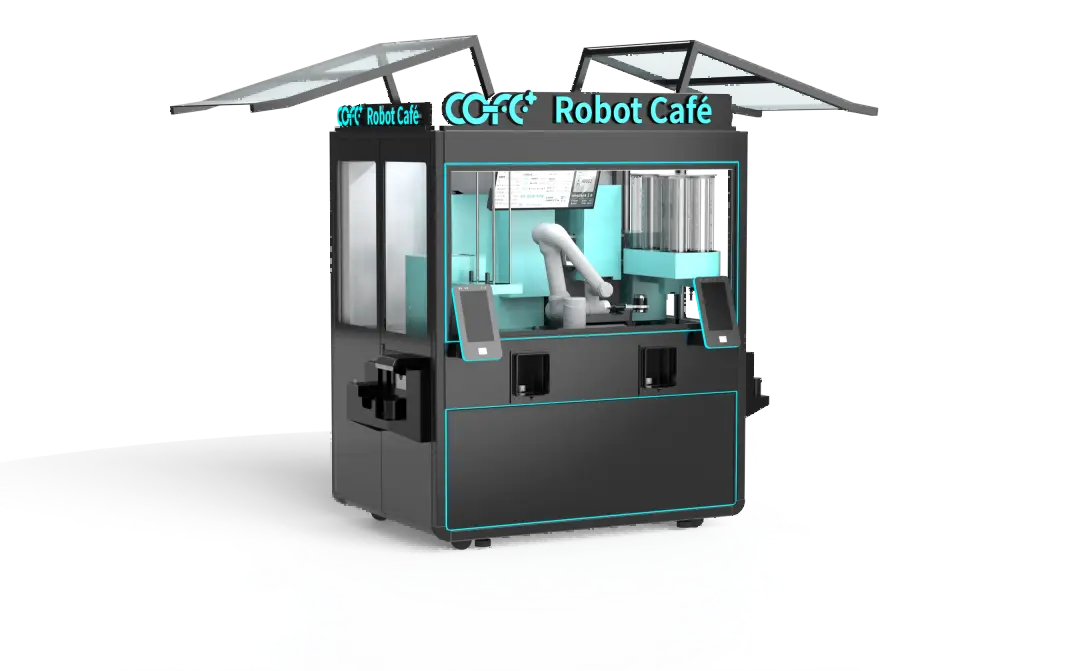
This remote layer also means recipe improvements propagate instantly. When the beverage development team refines a matcha latte foam profile or introduces a new oat milk calibration, every connected machine receives it. That’s fundamentally different from a static coffee vending machine where the dispense mechanism is fixed and only the powder cartridge changes. A robot barista is a software-driven platform, and the coffee quality actually improves post-installation as the model learns from aggregate data.
Independent validation matters when you’re investing in a fleet. COFE+ passed food safety and equipment reliability certifications in over 18 developed markets—FDA, CE, UKCA, KC, SASO—each with their own testing requirements. But beyond certifications, the operational data is what convinces operators. During durability testing, one unit ran for over 500,000 consecutive drink cycles while maintaining extraction yield between 18% and 22%, never drifting outside that window. That’s roughly five years of heavy commercial use. The robotic arm repeated the same latte art design—a tulip pattern—with a spatial accuracy of ±0.3 mm, something human hands simply cannot match over thousands of repetitions.
In a deployment at a Middle Eastern airport, four kiosks served over 1,000 cups per day with a taste panel consistency score above 90 (on a 100-point Q-grader scale) for twelve consecutive weeks. The operator recorded fewer than 0.2% customer complaints related to taste, which is lower than most staffed specialty bars achieve on a single shift. The machines also logged every drink parameter, giving the operations team a granularity of quality data that a manual café could never produce. For investors who ask “how do I know every cup will taste the same?”, the answer isn’t a promise—it’s a data stream.
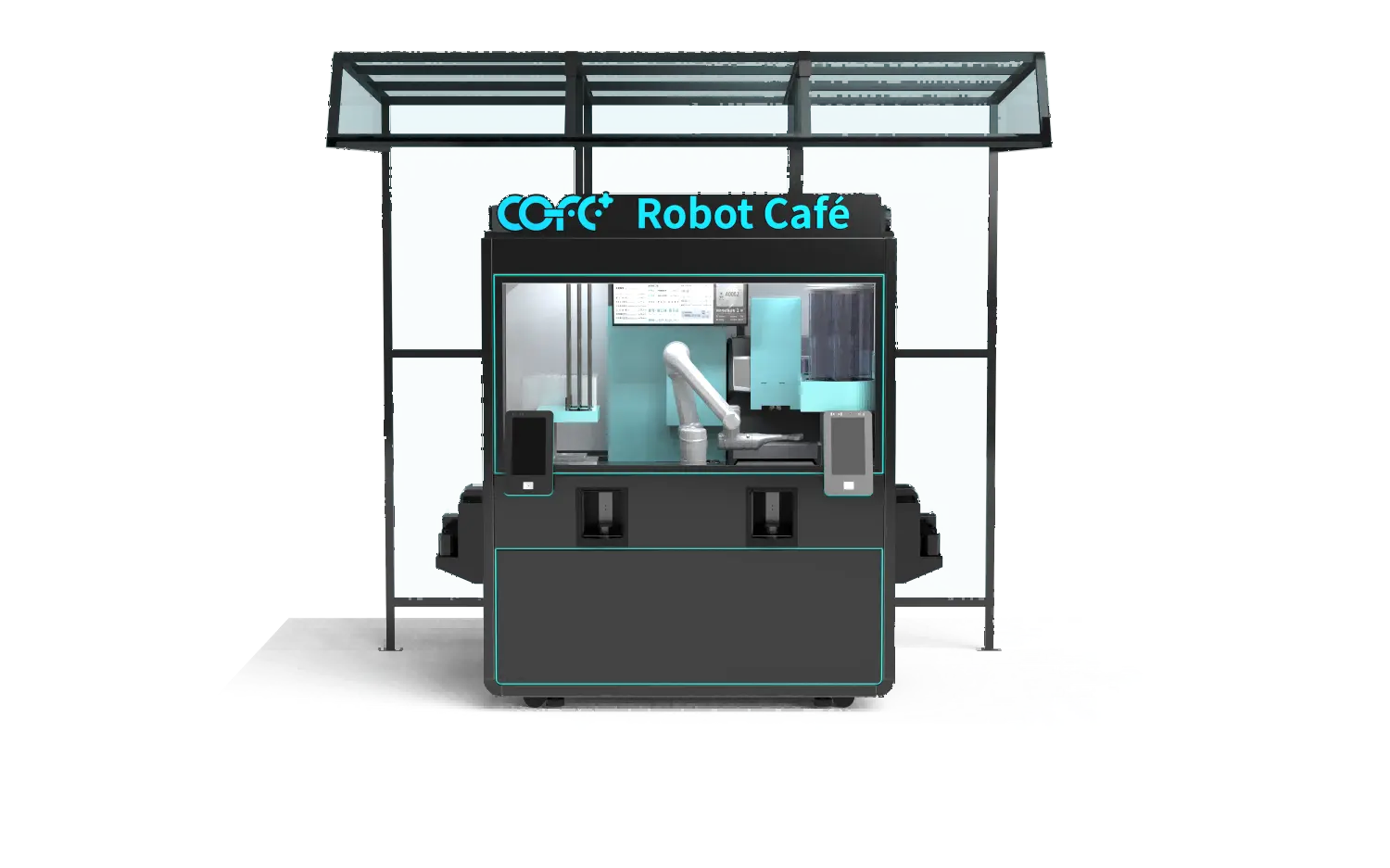
When you remove the human variable from quality control, you also remove the bottleneck on expansion. Traditional coffee chains spend weeks training baristas, and even then, high staff turnover erodes quality. A robot kiosk doesn’t require training; the machine IS the training, because the recipe is the executable logic. That means you can open twenty new locations in a month, and the first cup served at the newest site will be identical to the hundred-thousandth cup at your oldest one.
The economics reflect this stability. With a cost per cup around $0.30–$0.70 and no barista wages, a single kiosk can recover its investment in 6 to 12 months at moderate foot traffic. But the underappreciated financial lever is quality consistency itself. Inconsistent quality leads to brand dilution, negative reviews, and customer churn, costs that are hard to quantify but deadly for multi-site coffee brands. I’ve talked to operators who opened a fifth location only to see overall same-store sales drop because the new barista team couldn’t match the original store’s quality, and foot traffic fractured between inconsistent outlets. Robotics make that scenario obsolete.
The strategic implication is that your expansion plan decouples from the labor market. You can focus on real estate and customer flow, confining the quality process to routine maintenance and remote monitoring, rather than daily personnel management. Forward-thinking operators are already building their five-year plans around this assumption.
In a properly maintained unit, manual taste calibration is not necessary because the self-diagnostics run daily. The machine automatically flushes the group head, cleans the steam wand at 85°C, and recalibrates its sensors. If a component drifts, such as a slightly worn grinder burr, the machine logs the drift and notifies the operations team before it affects any drink. The only manual task is replenishing consumables and occasionally replacing wear parts on a schedule that the cloud platform reminds you of.
The primary flavor determinants in coffee—extraction yield, water chemistry, milk temperature, and foam texture—are measurable physical properties, not expressions of artistry. A robot that controls these properties within tighter tolerances than a human will, by definition, produce a more analytically consistent cup. If the digital recipe is designed by professional coffee developers, the output in a blind tasting is indistinguishable from a skilled barista executing the same recipe perfectly. In fact, we’ve seen instances where panelists rate the robot’s consistency higher because it never has an “off” shot.
The kiosks include a multi-stage water filtration system plus a hardness sensor. The machine adjusts mineral dosing to bring the water profile into SCA (Specialty Coffee Association) optimal range before brewing, regardless of local supply. For large-scale deployments, our engineering team pre-audits the water report for each proposed site and sets the filtration configuration accordingly before shipping.
Yes, and this is actually one of the strongest arguments for robotic milk management. Oat, almond, and soy milks foam differently depending on brand, temperature, and age. The robot’s steam wand includes a pressure feedback sensor that detects the foam resistance and adjusts injection time dynamically. This adaptive algorithm has been validated across dozens of plant milk brands in European and Asian markets, and the foam quality variance is about one-tenth of what you’d see with human baristas switching between alternative milks during a rush.
We recommend starting with a two-unit pilot in different traffic environments—say, a high-volume university and a medium-volume office tower—and tracking drink-to-drink consistency via the cloud dashboard over 90 days. That gives you enough data to compare taste panel scores, customer complaints, and service times across different conditions. Send your intended locations to sales@hi-dolphin.com or call +86 131 6630 1290, and we’ll set up a pilot parameter plan tailored to your sites.
TL;DR — COFE+ is a fully automated robotic coffee kiosk that grinds fresh beans, brews espresso and lattes, creates latt……
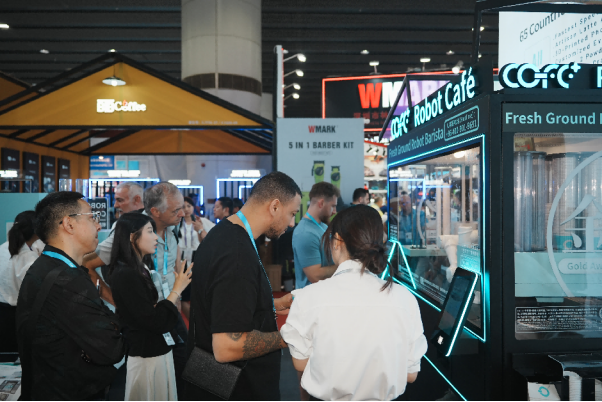
7th-Genertion Smart Robot Coffee Kiosk Arrives at the Belt and Road Core Hub, Ushering in a New Service Era Along t……
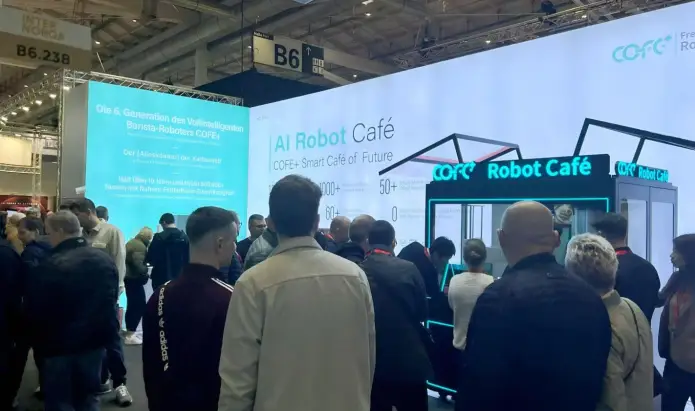
CHICAGO, May 12, 2026 (GLOBE NEWSWIRE) – Shanghai Hi-Dolphin Robot Technology today announced the U.S. debut of its 7th‑……