The Rise of Professional Robotic Café Technology: What COFE+ Is and Why It Matters
TL;DR — COFE+ is a fully automated robotic coffee kiosk that grinds fresh beans, brews espresso and lattes, creates latt……

Choosing between an automated coffee kiosk, a robot coffee bar, and a built-in counter comes down to three questions: how much floor space can you give up, what kind of customer interaction fits your venue, and how fast do you need to recover the investment. Each format solves a different operational problem, and picking the wrong one usually means either wasted square meters or a machine that sits idle because it does not match the traffic pattern.
This breakdown covers footprint, throughput, cost structure, and placement logic for each category, using the COFE+ 7th-generation line from Shanghai Hi-Dolphin Robot Technology Co., Ltd. as the reference point. The same decision framework applies to any comparable system on the market.
The labels sound interchangeable until you try to fit one into an actual site. A robot coffee kiosk is a freestanding unit built for speed in tight spaces. A robot coffee bar adds seating or counter depth, turning the service point into a destination. A robot coffee counter is a built-in module designed to disappear into a premium interior while still delivering full barista-level output.
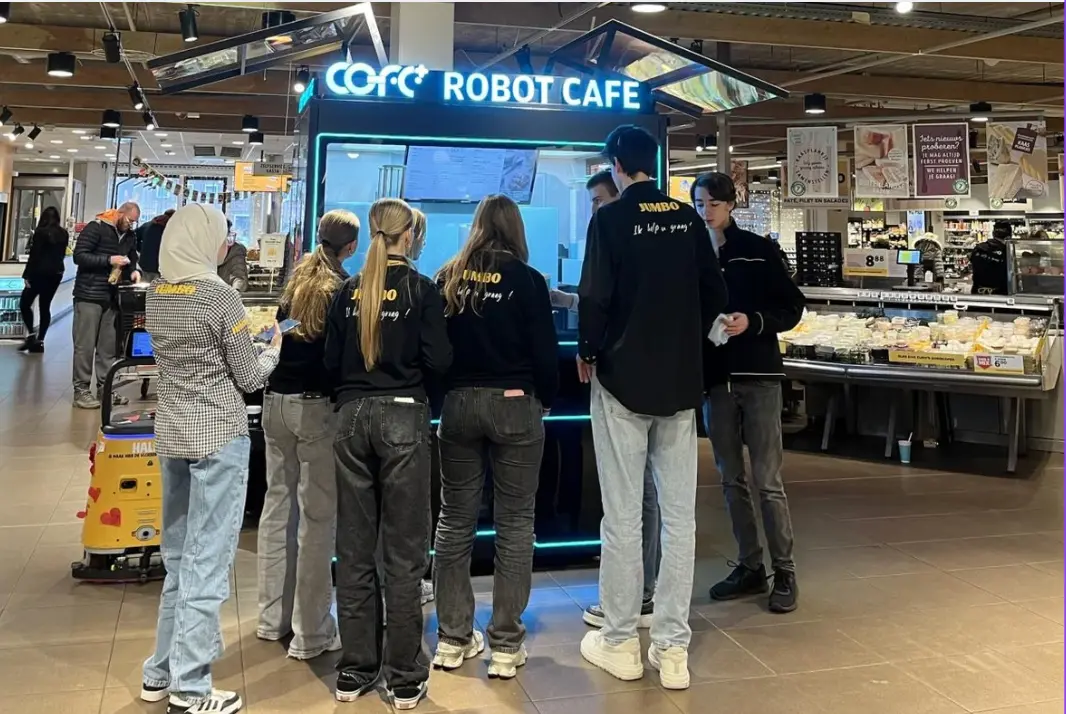
The COFE+ 7th-generation kiosk occupies 2.35 square meters and finishes a cup in 43 to 60 seconds. It handles over 300 drink options and runs unattended around the clock. The bar version folds into roughly 2 square meters, then expands into a four-seat social hub when traffic allows. The counter version fits the same footprint but is designed for open-view installation, letting guests watch the robotic arm work through the entire extraction and latte-art sequence.
| Specification | COFE+ 7th-Gen Kiosk (Indoor) | COFE+ 7th-Gen Robot Coffee Bar | COFE+ 7th-Gen Robot Coffee Counter |
|---|---|---|---|
| Footprint | 2.35 m² | ~2 m² folded | ~2 m² |
| Throughput | 43–60 seconds per cup | Full robotic grinding, extraction, latte art | Full robotic barista service |
| Menu depth | 300+ drinks, 5,000+ combinations | 350+ drinks, full customization | 300+ drinks, 5,000+ combinations |
| Signature feature | 3D photo and logo printing, robotic latte art | Transforms from counter to 4-seat bar | Open-view “coffee theater” setup |
| Best fit | High-traffic indoor public spaces | Hotels, airports, offices, universities | Luxury hotels, VIP lounges, high-end retail |
The table makes the trade-offs visible. A kiosk maximizes cups per hour per square meter. A bar trades some of that density for dwell time and social value. A counter sacrifices nothing on output but assumes you have an interior worth showcasing it in.
Floor space is the first constraint most operators hit. A 2.35-square-meter kiosk fits into a corner of a transit concourse or a lobby alcove. A bar needs room for the seating configuration to deploy without blocking foot traffic. A counter requires integration into cabinetry or a service wall, which means design coordination and sometimes construction lead time.
Operational cost is where automated systems pull ahead of staffed setups. The COFE+ line runs at roughly $0.30 to $0.70 per cup in ingredient and consumable cost, with no wages, benefits, or shift scheduling to manage. A staffed espresso bar in a comparable location might spend three to four times that per cup once labor is factored in, and it still cannot run 24 hours without adding headcount.
ROI timelines for robot coffee kiosks typically fall between 6 and 12 months, depending on location, pricing, and daily volume. The math is straightforward: eliminate the largest variable cost (labor), keep the machine running through hours when a staffed bar would be closed, and capture the repeat traffic that consistent quality generates. A bar or counter in a premium venue may take slightly longer to break even because the installation cost is higher, but the margin per cup is also higher if the venue supports premium pricing.
Location quality matters more than format choice. A kiosk in a dead corner of a mall will underperform a counter in a busy hotel lobby, regardless of the hardware. The format decision should follow the traffic analysis, not the other way around. If the site has high footfall but short dwell time, a kiosk wins. If guests linger and expect an experience, a bar or counter justifies the extra investment.
Unattended operation only works if the machine can monitor itself and call for help before a problem becomes a breakdown. The COFE+ line uses AI for recipe management and predictive maintenance, flagging components that are drifting out of spec before they fail. IoT connectivity pushes inventory levels, sales data, and system status to a cloud dashboard, so a single operator can oversee dozens of units across multiple sites.
In one deployment across multiple corporate cafeterias, the client cut labor expenditure for coffee service by roughly 70 percent after switching to automated units. The machines ran around the clock without shift changes, and the consistency of the output kept repeat rates high. Remote monitoring meant the operations team could schedule restocking runs based on actual consumption rather than fixed intervals, which reduced both waste and stockouts.
Scalability follows from the same architecture. Once the first unit is dialed in, replicating it across new sites is a logistics exercise, not a hiring and training project. The modular design means a new kiosk can be operational within weeks if the site is ready and permits are in place.
Peak demand is where automation earns its keep. A human barista slows down under pressure, makes more errors, and eventually burns out. A robotic arm does not. The COFE+ kiosk can push through roughly 1,000 cups per day at a sustained pace of under a minute per cup. Cloud monitoring triggers restocking alerts before ingredient bins run dry, so the machine never has to stop mid-rush because it ran out of milk.
Regulators treat unattended food service with extra scrutiny, and for good reason. A machine that dispenses beverages without a human present needs built-in safeguards that a staffed bar can handle through manual intervention.
The COFE+ outdoor kiosk includes a fully enclosed waste system, anti-microbial stainless-steel interior surfaces, and automatic high-temperature sterilization at 85°C or above. These features address the hygiene concerns that come with any fresh retail operation, but especially with one that might sit in a public space for hours between service visits.
Shanghai Hi-Dolphin has accumulated over 50 certifications across more than 18 developed countries, including FDA, CE, UKCA, KC, and SASO. That certification stack is not just a compliance checkbox; it is the documentation a franchise partner or property manager needs before they will sign off on installation. If you are evaluating any automated coffee system, ask for the certification list early. A vendor who cannot produce it is not ready for serious deployment.
The short answer is yes, if the manufacturer has done the work. Reputable systems use food-grade materials, automated cleaning cycles, and controlled ingredient storage. The certifications listed above cover the major regulatory frameworks, but local health departments may have additional requirements. Check with your jurisdiction before committing to a site.
Strategic placement is where most automated coffee projects succeed or fail. The technology is mature enough that the hardware rarely disappoints; the mistakes happen when someone installs a premium counter in a location that needed a fast-turnover kiosk, or vice versa.
Kiosks belong in transit hubs, shopping malls, university buildings, and corporate lobbies where people want a cup and want it fast. Robot coffee bars fit hotels, co-working spaces, and event venues where the coffee service is part of the experience, not just a utility. Counters are for luxury environments (VIP lounges, high-end retail showrooms, private clubs) where the visual presentation matters as much as the beverage.
The installation process for a freestanding kiosk is minimal: deliver, connect power and water, load ingredients, and go. A bar or counter may require coordination with interior designers and contractors, which adds lead time but also adds value if the integration is done well.
If you are unsure which format fits your site, the question to answer first is: what is the customer doing before and after they order? If they are rushing to a gate or a meeting, speed wins. If they are settling into a lounge or waiting for a colleague, experience wins. The format follows from that.
A freestanding kiosk can be operational within a few weeks if the site has power, water, and the necessary permits. Built-in counters take longer because they depend on construction schedules and interior fit-out. Budget four to eight weeks for a straightforward kiosk deployment, longer if customization or permitting is complex.
Routine maintenance includes daily cleaning cycles (automated), ingredient replenishment (scheduled based on consumption data), and periodic technical inspections. Remote monitoring catches most issues before they cause downtime. Plan for a technician visit every few weeks under normal operation, more frequently during the first month as you dial in the restocking rhythm.
Yes. The COFE+ line supports over 300 drink options and thousands of customization combinations, covering espresso-based drinks, specialty beverages, and cold options. Menu depth depends on the ingredient reservoirs installed, so discuss your target menu with the vendor during specification. For questions about deployment, customization, or site evaluation, reach out to Shanghai Hi-Dolphin at sales@hi-dolphin.com or +86 131 6630 1290.
TL;DR — COFE+ is a fully automated robotic coffee kiosk that grinds fresh beans, brews espresso and lattes, creates latt……
7th-Genertion Smart Robot Coffee Kiosk Arrives at the Belt and Road Core Hub, Ushering in a New Service Era Along t……
CHICAGO, May 12, 2026 (GLOBE NEWSWIRE) – Shanghai Hi-Dolphin Robot Technology today announced the U.S. debut of its 7th‑……